Full legend
The story
Along the iconic Avenida Juárez, right where the ancient trees of the Alameda Central stretch their branches like weary fingers over the asphalt of the Cuauhtémoc borough, the ground safeguards a liquid memory. Old chroniclers of the Historic Center whisper that the legend of "The Drunken Fountains" comes to life only when the modern tide ebbs and the surroundings freeze during that "strange hour": that chilly sigh between midnight and dawn when the urban clamor dies down, and Latin America's oldest park seems to reclaim its ancestral breath to warily observe whoever walks its paths.
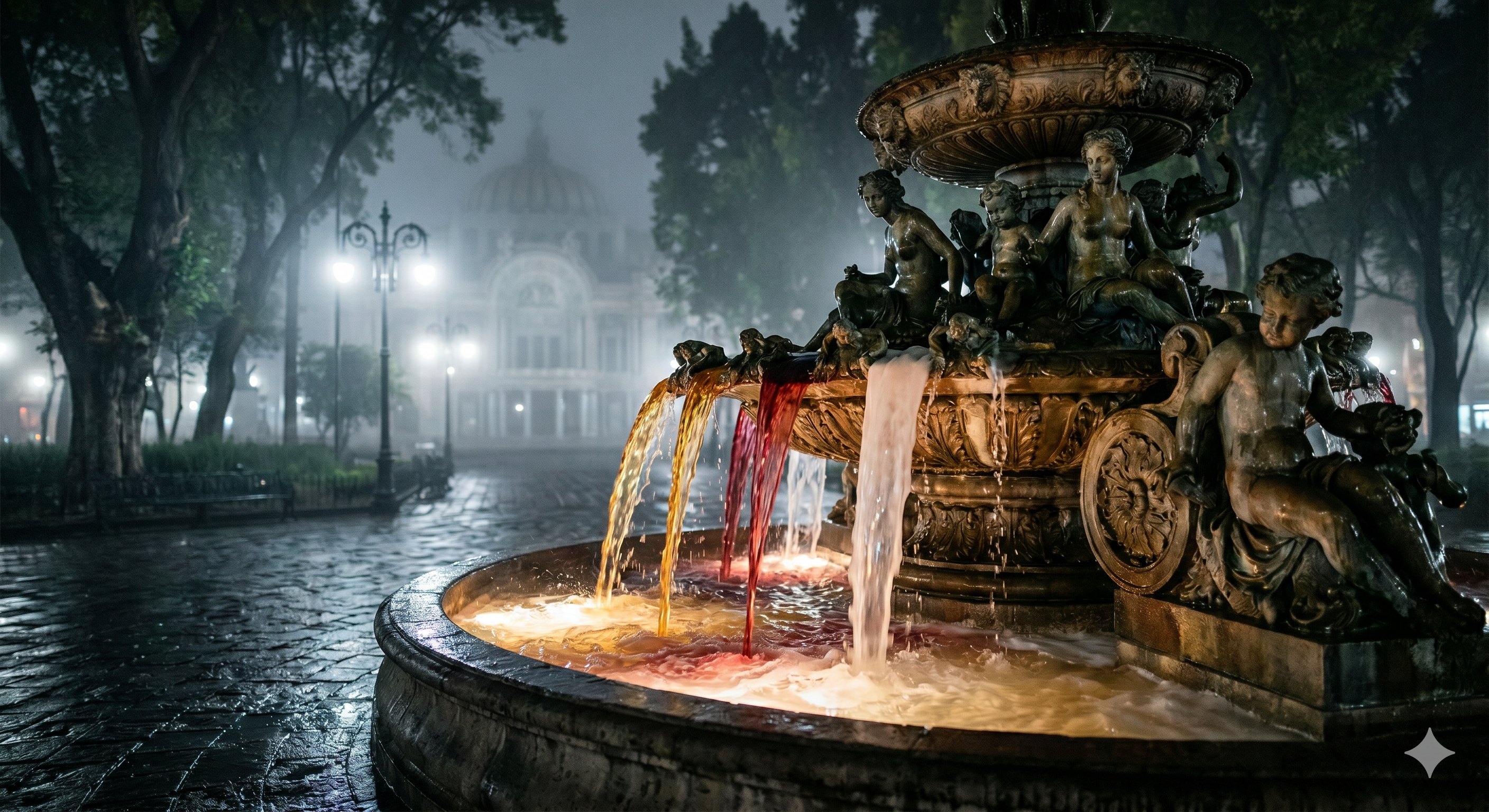
The phenomenon does not rely on crude horror or the harrowing wails of common folklore. It begins subtly, almost festively, with a drastic shift in the atmosphere: the ambient dew becomes saturated with a persistent, sweet aroma of consecrated wine, fine pulque, and aged spirits that seem to pour directly from the bronze and marble sculptures. The fountains' water trades its crystal-clear murmur for a thick, amber bubbling, transforming the public space into an illusion of opulence and perpetual celebration. It is as if the wind opened a crack into past centuries, unleashing the echoes of viceregal toasts, independence conspiracies, and sumptuous Porfirian promenades left unfinished beneath the soil.
Elders who guard the oral tradition assure that this presence does not seek to terrify out of mere malice. It manifests as a living warning so that no one forgets the dense layers of history cementing the Alameda: its cloak-and-dagger duels of honor, its clandestine devotions, the ancient trades of the water-bearers, and the footsteps of those who purged their excesses on this very ground. The legend is anchored to its geography; it demands the stone of the plaza, the fountain's reflection, and the shadow of the canopy to materialize. Easy gain and unbridled joy appear in the water as a magnetic omen, but the territory always claims its tribute: it demands silence, absolute obedience, or a spiritual debt that the unsuspecting traveler will wake up paying long after.
Oral memory
Origin of the story
The Drunken Fountains of the Alameda grows from a popular reading of Alameda Central. The cited source anchors the site and its historical context; the legend uses that ground to tell what the neighborhood imagines, fears, or preserves.
Territory
Territory and atmosphere
The story is set at Avenida Juárez s/n. That point is not decorative: the street, plaza, market, church, canal, or hill explains why the apparition is told there and not elsewhere in Cuauhtémoc.
Cultural reading
Cultural reading
The key to the tale is the old story of fountains filled with alcohol, turning public space into feast and warning. As an urban and neighborhood legend, it turns a territorial detail into warning, memory, or wonder so the local past can keep speaking inside the present city.