Full legend
The story
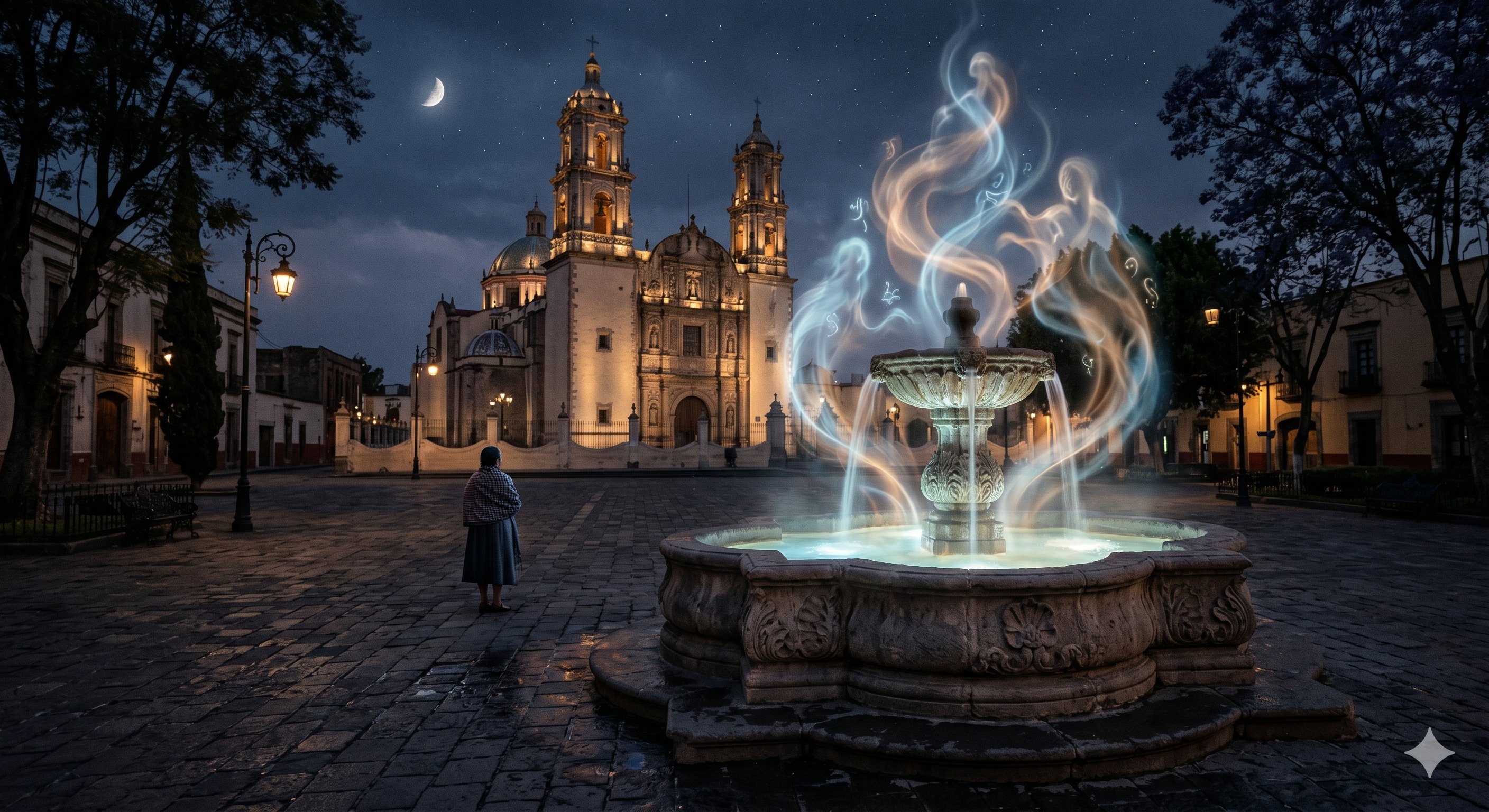
At the precise intersection of Avenida Revolución and Plaza del Carmen, in the heart of Álvaro Obregón, the pavement seems to surrender to memory. Local lore tells that the "Whispering Fountain" only appears when the area falls into that "strange hour": that brief interval at dusk or dawn when the roar of traffic fades, and the neighborhood seems to reclaim its identity to recognize those walking its streets.
The apparition is not violent, nor does it announce itself with piercing cries. It begins subtly with the sound of running water—a bubbling murmur that seems to rise from nowhere, repeating ancient names and forgotten surnames that once echoed through the halls of the old College of San Ángel Mártir. It is as if the street opens a crack into unfinished business, allowing the colonial past to seep through the fissures of modernity.
Local tradition claims this phenomenon does not seek to terrify out of malice. Its purpose is permanence: a liquid reminder so that no one forgets what stood there before the great avenues: the San Ángel of Carmelite orchards, silent devotions, duels of honor, and ancient trades. Thus, the legend is anchored to the soil; it requires the stones of the plaza, the shadow of the temple, and the echo of the market to take form.
Those who cross the site with arrogance or ignorance of its history will first hear a thin thread of a voice, easily mistaken for the wind. But if the traveler persists in their disrespect, the murmur becomes sharp, and the street returns—with chilling clarity—the name of someone no longer of this world, a reminder that in San Ángel, those who have passed have never truly left.
Oral memory
Origin of the story
The Whispering Fountain of San Ángel grows from a popular reading of San Ángel colonial. The cited source anchors the site and its historical context; the legend uses that ground to tell what the neighborhood imagines, fears, or preserves.
Territory
Territory and atmosphere
The story is set at Avenida Revolución y Plaza del Carmen. That point is not decorative: the street, plaza, market, church, canal, or hill explains why the apparition is told there and not elsewhere in Álvaro Obregón.
Cultural reading
Cultural reading
The key to the tale is water that seems to repeat old names when the square falls quiet. As an urban and neighborhood legend, it turns a territorial detail into warning, memory, or wonder so the local past can keep speaking inside the present city.