Full legend
The story
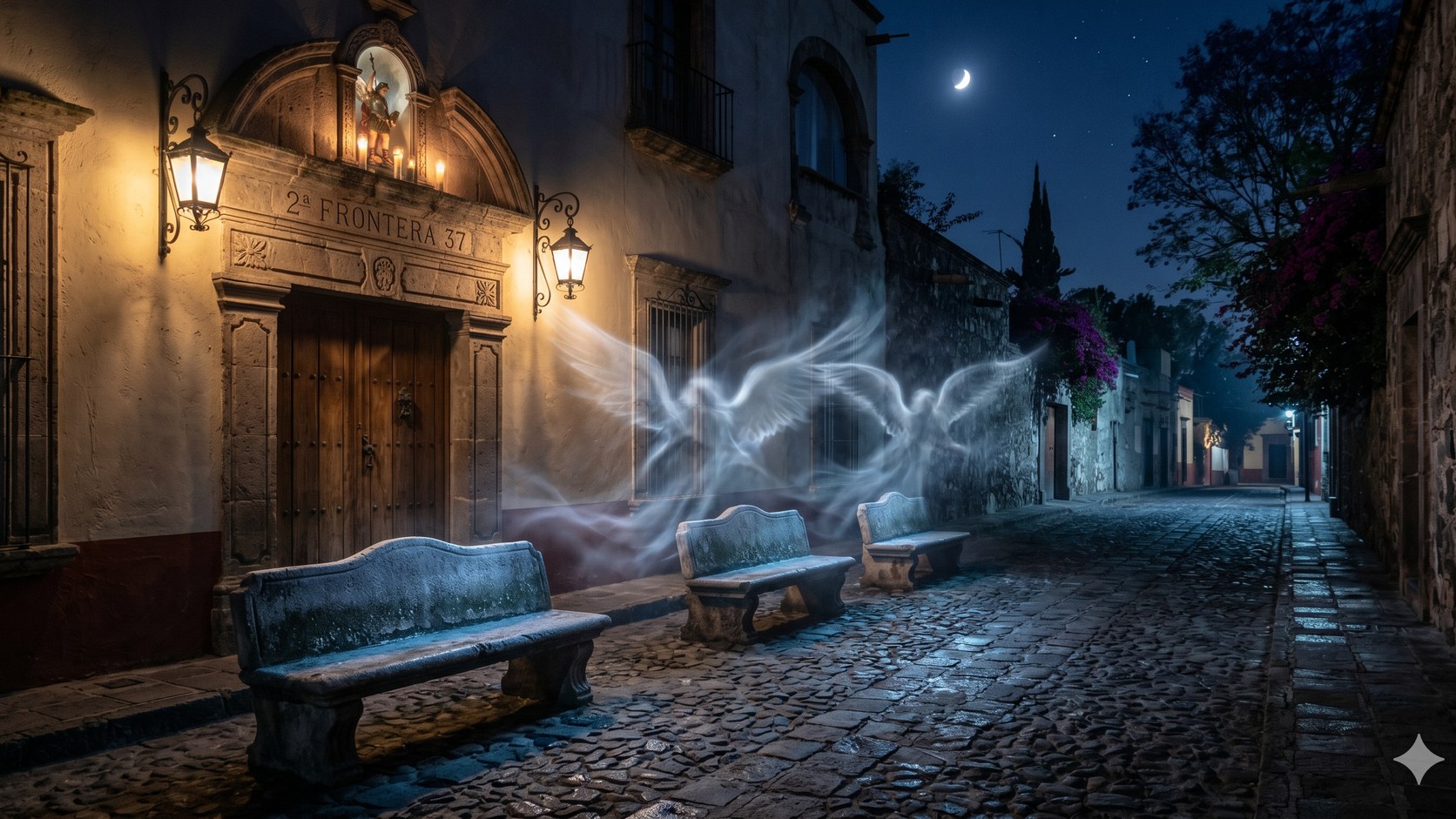
At the threshold of the house marked number 37 on the second street of Frontera, in San Ángel, time behaves differently. Those who live in this corner of Álvaro Obregón say that the "Archangels of Frontera" only appear when the city's noise surrenders to the "strange hour": that deathly silence before dawn where the neighborhood seems to regain its memory and sternly observes those who walk its stones.
The presence does not announce itself through ethereal apparitions, but through three stone benches that guard the vicinity. Neighbors claim these seats undergo a drastic change in temperature, turning as cold as crypt marble just before bad news strikes the community, as if the street itself were an oracle warning of what is about to descend.
The legend maintains that these entities do not seek gratuitous fright, but rather rectification. They manifest so that the modern inhabitant does not forget the San Ángel of deep devotions, duels of honor, and the ancient footsteps that forged the identity of the south. It is a warning against "hollow custom": the signal does not arrive to be admired, but to shake those who have forgotten that faith, in this colonial corner, requires respect and not just habit.
Those who walk down Frontera with a distracted soul will feel a sudden chill in their hands as they pass the benches; those who do so with arrogance will hear the beat of invisible wings, reminding them that, in this corner, the past still watches over what the present neglects.
Oral memory
Origin of the story
The Archangels of Frontera Street grows from a popular reading of San Ángel colonial. The cited source anchors the site and its historical context; the legend uses that ground to tell what the neighborhood imagines, fears, or preserves.
Territory
Territory and atmosphere
The story is set at 2a Frontera 37. That point is not decorative: the street, plaza, market, church, canal, or hill explains why the apparition is told there and not elsewhere in Álvaro Obregón.
Cultural reading
Cultural reading
The key to the tale is three stone benches said to change temperature before bad news arrives. As an urban and neighborhood legend, it turns a territorial detail into warning, memory, or wonder so the local past can keep speaking inside the present city.