Full legend
The story
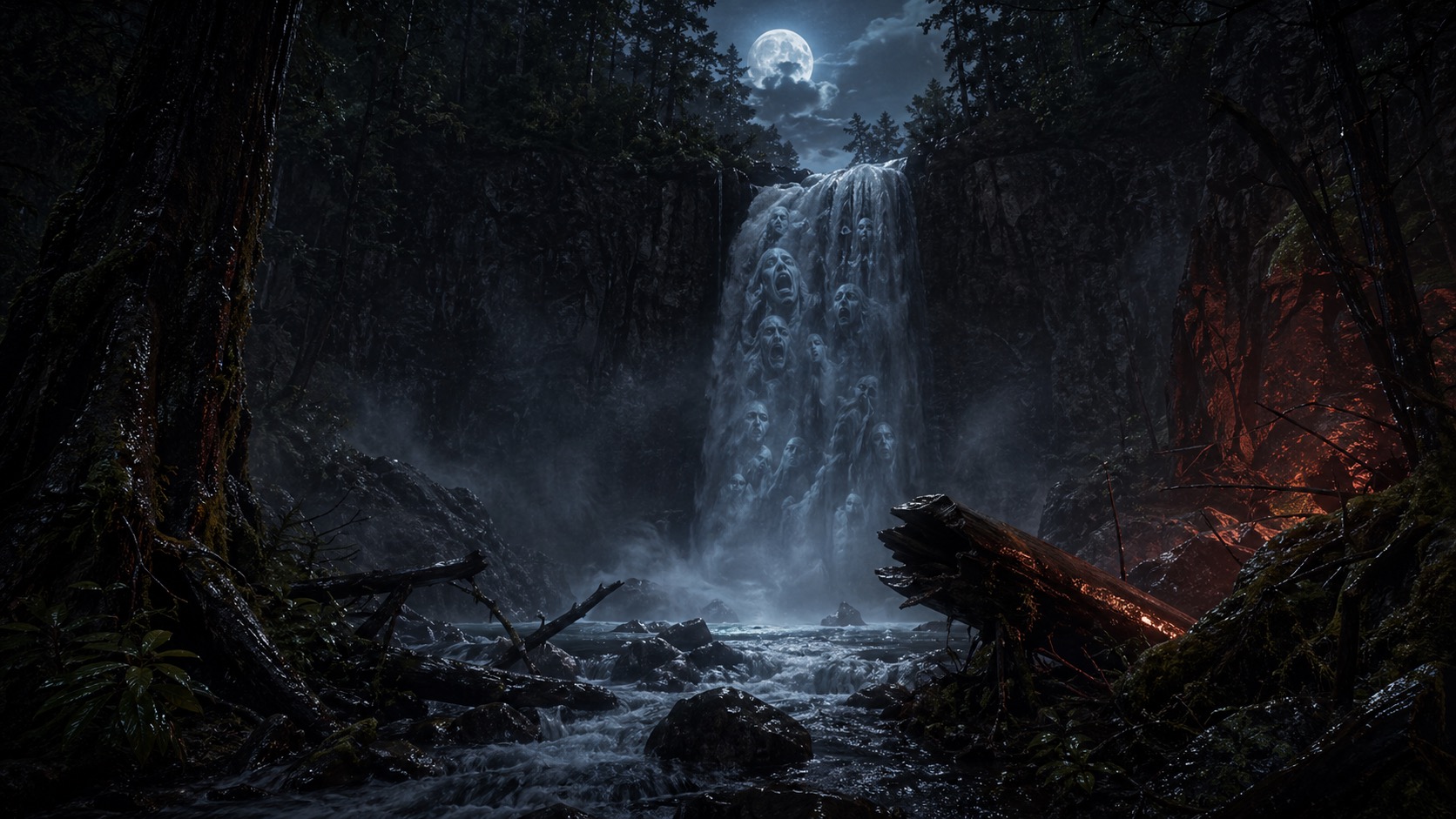
High in the mountains of Tlalmanalco there is a waterfall whose sound changes with the hour of day. In the afternoon it seems like clean water falling over rock; at midnight, woodcutters swear it no longer sounds like a river at all, but like a layered chorus of voices calling men by their trade and asking them not to keep cutting. It is not a gentle plea. It is a stubborn lament that makes it impossible to raise the axe without shame.
The legend says these are the souls of the forest speaking through the current. No one has seen figures or specters beside the fall, yet more than one person has returned with the wood untouched. In the sierra, the warning is well understood: when water begins to sound like speech, the mountain has decided to intervene.
Once a group of young men tried to mock the story and went up with machetes to prove the waterfall was nothing but water noise and superstition. Before midnight they began to hear their own names mixed into the roar. It was not one voice but several, some old, some almost childlike, all pronouncing clearly what the water should not have known. They ran down the slope leaving tools behind, and the next day one of them returned alone to recover his machete and found the trunks around the clearing marked by fresh cuts, as if someone had struck first.
The Waterfall of Laments works not only as a haunting but as a moral boundary of the mountain. In Tlalmanalco people say there are days for cutting and days for turning back, and that the forest eventually makes itself heard when too much is demanded of it. That is why, though many hear the story with skepticism, few risk working by the water at midnight. The legend has survived because the forest still needs a voice, and human voices have not always been enough to defend it.
Oral memory
Origin of the story
The Waterfall of Laments lies in a wooded stretch of the Tlalmanalco highlands that already feels, in the journey toward it, like a separation from ordinary life. The story says the waterfall changes its sound with the hour and that at midnight what is heard no longer resembles water but a chorus of voices asking that the forest not be cut down. The people who have most consistently carried the story through generations are the woodcutters who worked in the zone, and they tell it not as fantasy but as the description of something they heard and that made them lower the axe. The waterfall does not threaten or injure. It simply speaks, and what it says is clear enough for anyone willing to listen.
Territory
Territory and atmosphere
The fir and pine forest in the higher reaches of Tlalmanalco has a density that produces its own acoustics. Wind through the trees, water in the channels, and animal movement generate a sound field that changes with the hour in ways that are not random but tied to precise atmospheric conditions. At midnight, when the temperature drops and the wind shifts direction, the falling water can reverberate between rock walls and vegetation in a way the human ear processes not as hydraulic but as vocal. That real acoustic transformation is the base upon which the legend built its image of voices asking for respect for the forest.
Cultural reading
Cultural reading
The Waterfall of Laments is one of the few legends in the region with an explicit environmental function. It protects the forest by turning water into voice and hydraulic noise into a plea. By making the landscape speak, the story removes the distance between the human observer and the territory observed. The forest is not a resource but an interlocutor, and its requests carry the same weight as those of a person. In a context of pressure on the forests of the volcano region, that narrative conversion has a practical value that goes beyond literature. The woodcutters who heard the voices and stopped swinging the axe did exactly what the story asked, and the forest left standing that night is the same forest others will visit after them.