Full legend
The story
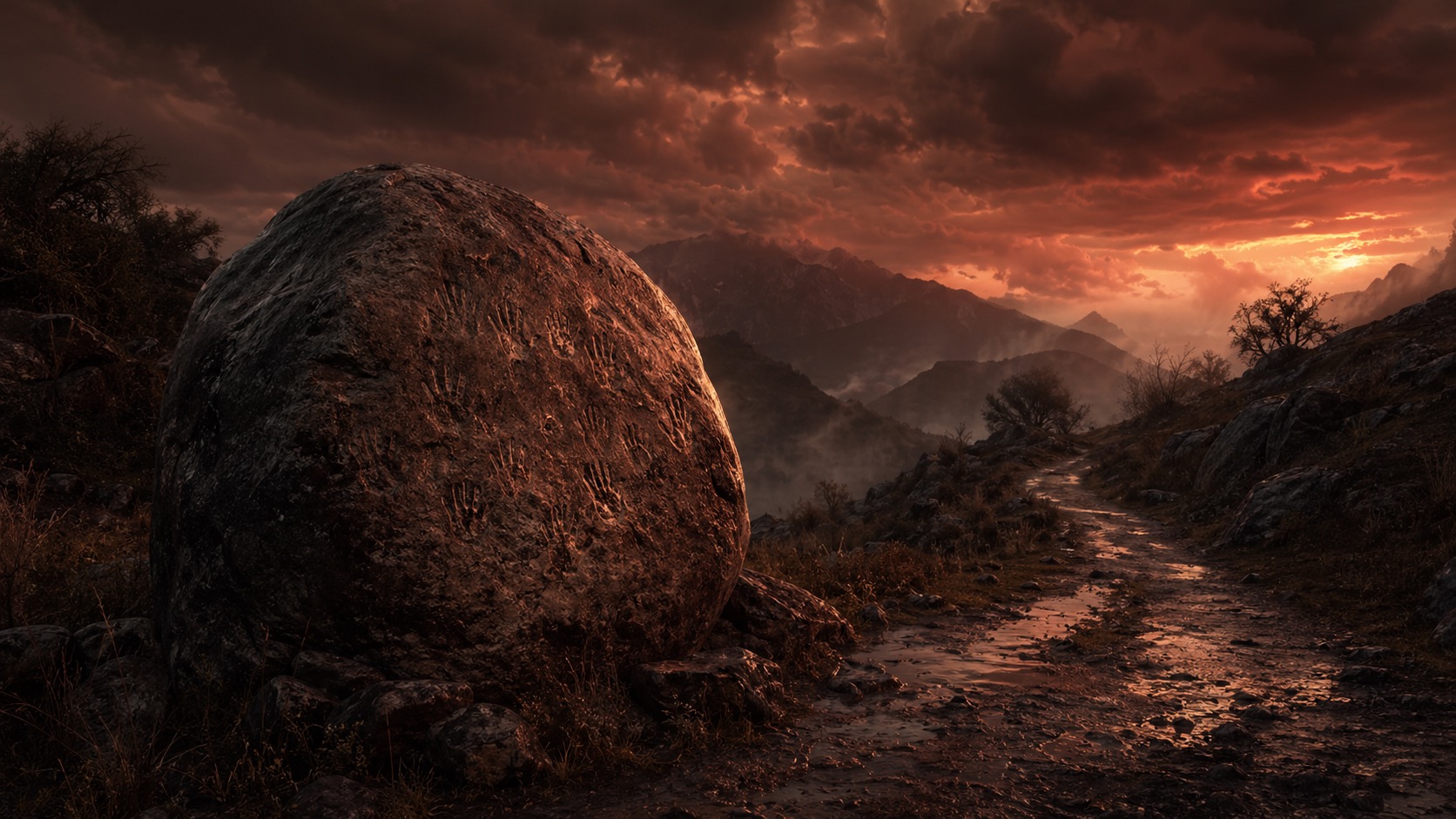
On the old road into the mountains there is a large, smooth rock where, people say, promises, disputes, and binding words used to be settled. It was enough to place a hand on the stone and speak plainly so that the mountain could hear. Whoever spoke the truth went on with life unburdened; whoever lied felt from that day onward that something had twisted in body or fortune, as if the rock kept memory better than any human being.
That is why even now there are people who avert their eyes when they pass it. No one wants to test whether the legend is still alive, but few dare to mock it either. In Tlalmanalco everyone knows the stone does not punish quickly: it waits. And precisely for that reason it frightens more than any immediate threat.
Grandparents used to tell that in earlier times boundary disputes, uncertain courtships, and work agreements were all brought there. If someone wanted to wash their hands of a lie, they were made to repeat it while touching the rock. Almost no one agreed. One man did so out of pride and lost a harvest first, then a mule, and finally the health of one leg. No one could prove that the stone punished him, but no one forgot the sequence either.
What makes this legend singular is that it depends on neither apparitions nor night sounds. Its force lies in waiting. The stone does not chase anyone or raise its voice; it simply remains. That may be why it intimidates more than many hauntings. In a world where nearly everything changes, the idea of a mineral surface that remembers better than we do what we swore is still enough to make even the bravest traveler pass by in silence.
Oral memory
Origin of the story
The Oath Stone belongs to a category of stories in which the landscape acts as a self-sufficient moral system. It needs neither judges nor human witnesses because the terrain itself records what is said upon it. According to tradition, the rock on the old road into the mountains was the place where important agreements in town were sealed aloud. Whoever lied after that ritual met, before long, with a misfortune no one could dismiss as chance. The story has shifted with the generations, but its core remains the same: the place remembers and exacts a price for deceit. Even now, people say, some townsfolk still avoid looking at it directly as they pass, just in case.
Territory
Territory and atmosphere
The old road up into the mountains of Tlalmanalco has the kind of topography that makes every bend feel like a place with its own name: curves, rises, stones, and crosses that elders can identify without hesitation even after years away. On such a route, singular geographic features accumulate history much more easily than on flat, uniform roads. The stone, large and somehow out of place along that stretch of path, already carries the visual condition of an exception, which makes it plausible to assign it a special function. The surrounding sierra and low forest, where many of the area's legends unfold, add a scale that makes the idea of a watching nature believable.
Cultural reading
Cultural reading
The Oath Stone functions as a moral technology for a small community. Instead of a legal apparatus, an object of the territory guarantees the pact. That substitution is not primitive but effective, because fear of punishment from the place often works better than fear of a fine or a sanction that may be delayed or never arrive. The story also says something about how communities organize trust: not through written contracts but through acts performed before witnesses who cannot be bribed or persuaded. That people still avoid looking at the stone head-on is less superstition than the result of centuries of a system that worked better than any notary might have guaranteed.