Full legend
The story
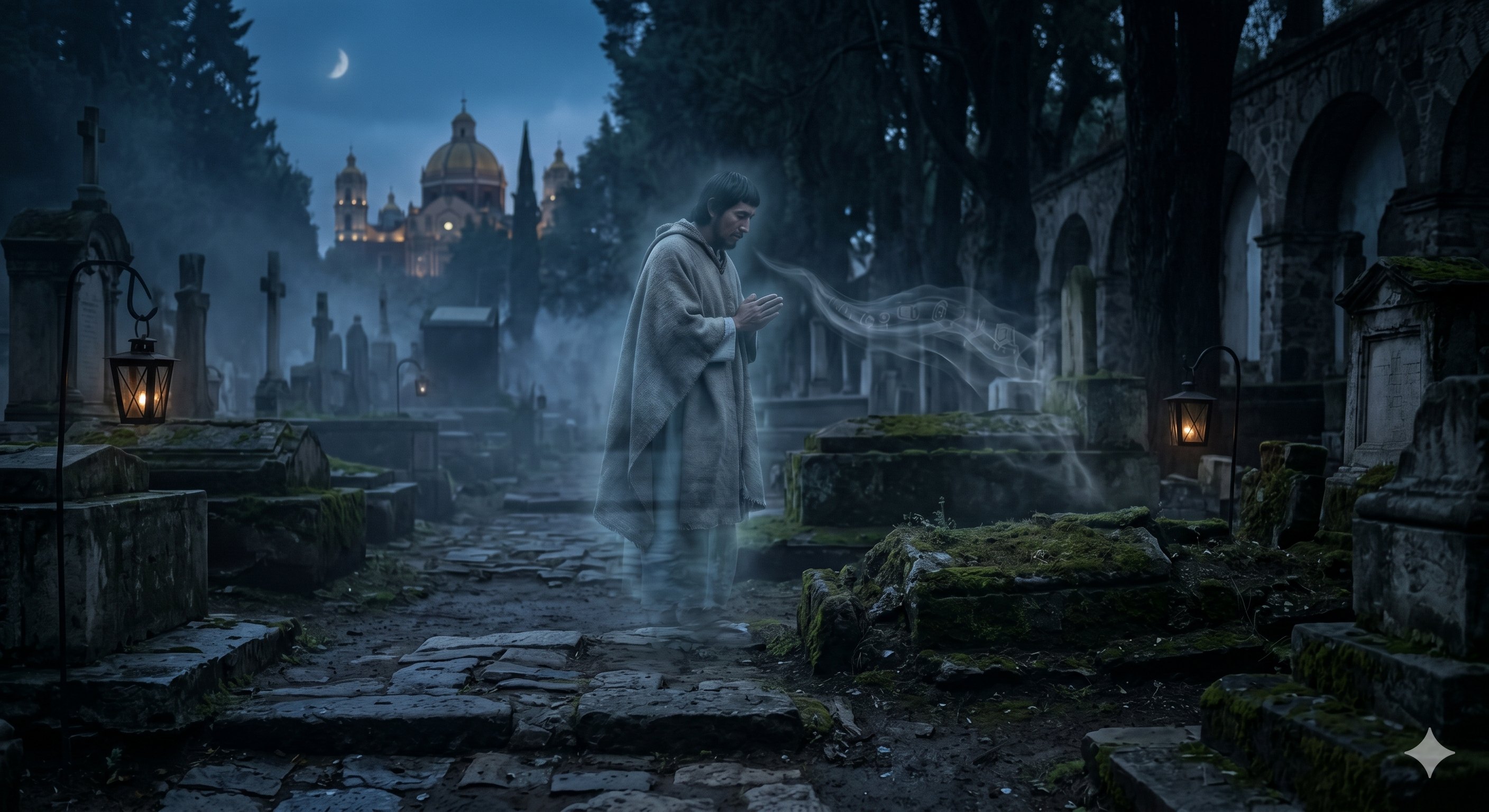
In the heart of the Gustavo A. Madero borough, where the Tepeyac Hill zealously guards its viceregal mysteries, the Panteón del Tepeyac—formerly known as the Cemetery of the Villa—stands as a sentinel of quarry stone. Inheritors of the oral tradition recount that the legend of "The Tomb Juan Diego Seeks" manifests not by whim, but when the city itself surrenders to a primal silence. It happens at that precise moment of deep twilight or just before dawn, when modern bustle lowers its guard, the thick, freezing mist of the ancient lake ascends to reclaim the territory, and the cemetery seems to contract to regain its ancient breath to recognize whoever walks without respect through its boundaries.
His manifestation does not follow conventional horror patterns; it does not burst in with harrowing wails or nightmare visions. The phenomenon begins subtly, like a sensory brush springing directly from the old quarry stone and the persistent aroma of melted incense. It begins with a cemetery that jealously preserves the ancient version of a burial impossible to verify, as if the street opened a sonorous and olfactory crack towards the fateful 16th century, returning the echo of the ancient Guadalupian devotions that remained pending on the Tepeyac above modern times.
The elders assure that these presences do not seek to frighten out of malice or morbid interest. He allows himself to be felt as an act of cultural resistance, acting as a sensory bond so that no one ignores what was there before: the viceregal Panteón del Tepeyac, its profound devotions, its forgotten sorrows, its vanished trades, and the rhythmic steps of the warriors and priests who forged this sacred territory over the lake. Therefore, the phenomenon demands this exact geography; it needs that specific corner, that square, that market, that temple, or that hill to take body and meaning. Those who travel with arrogance run the risk of hearing, in the murmur of the wind, the voice of someone who no longer belongs to this world, reminding them that in Gustavo A. Madero, those who left never truly left. It is the territory itself that speaks through its aromas and vibrations before written history attempts to explain it.
Oral memory
Origin of the story
The Grave That Seeks Juan Diego grows from a popular reading of Panteón del Tepeyac. The cited source anchors the site and its historical context; the legend uses that ground to tell what the neighborhood imagines, fears, or preserves.
Territory
Territory and atmosphere
The story is set at M. Salas s/n, Villa Gustavo A. Madero. That point is not decorative: the street, plaza, market, church, canal, or hill explains why the apparition is told there and not elsewhere in Gustavo A. Madero.
Cultural reading
Cultural reading
The key to the tale is a cemetery preserving an old version of a burial that cannot be fully verified. As an urban and neighborhood legend, it turns a territorial detail into warning, memory, or wonder so the local past can keep speaking inside the present city.