Full legend
The story
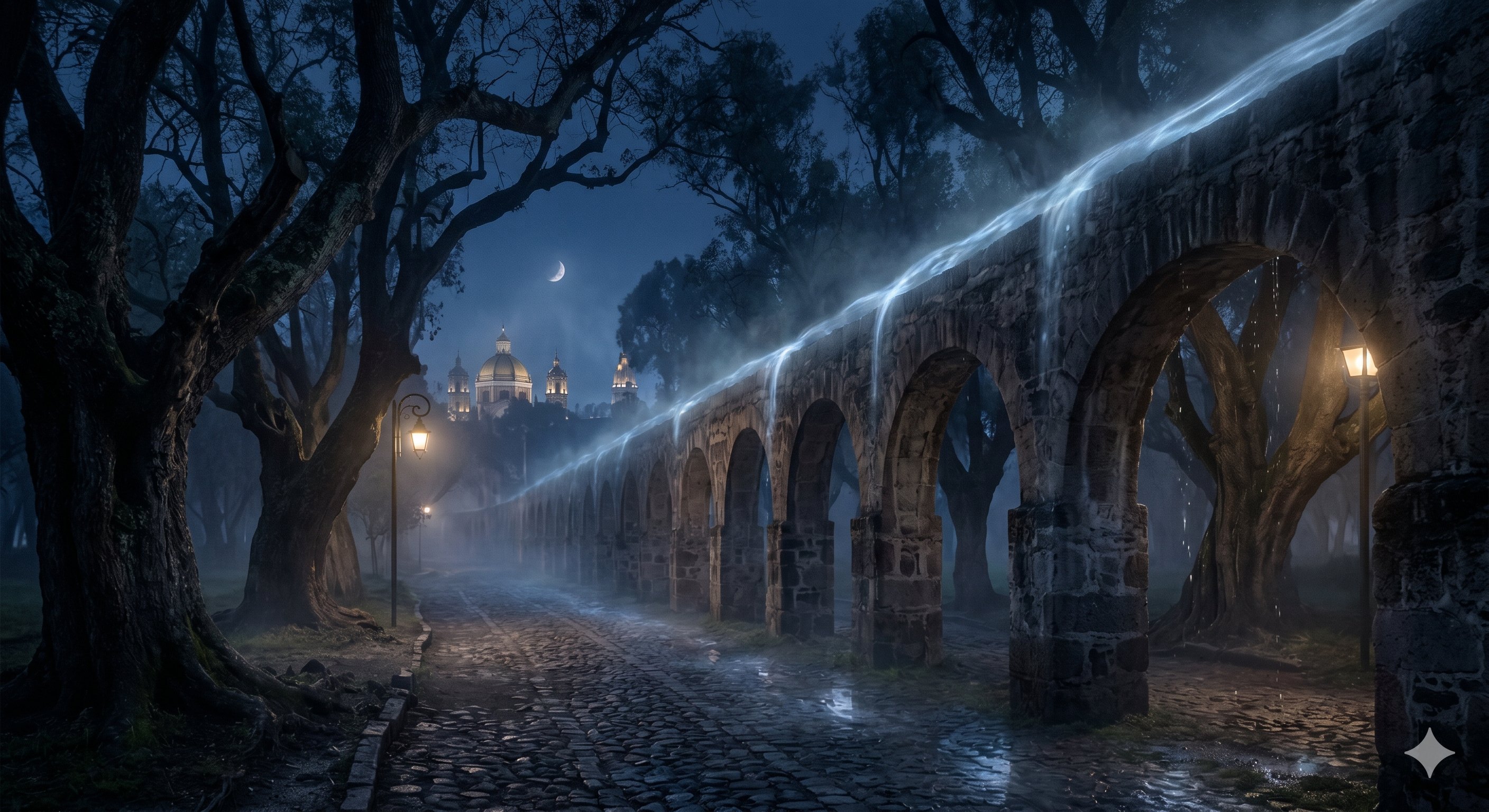
To the north of the capital, where the monumental stone arches of the Guadalupe Aqueduct cut through the horizon of the Gustavo A. Madero borough, the past refuses to run dry. Local chroniclers recount that the legend of "The Water That Never Leaves the Villa" comes to life in a subtle manner. It manifests during the driest nights of the year, at the precise moment when the asphalt releases the last breath of daytime heat and the roar of the avenue completely dies down. It is then that the surroundings seem to reclaim their viceregal shape to watch over solitary travelers.
The apparition does not rely on loud specters or spine-chilling wails. The phenomenon announces itself through the senses: the air suddenly turns incredibly cold, and a sharp aroma of wet earth and moss floods the environment. Those who walk alongside the colonial structure swear they can hear the crystalline, rhythmic murmur of an invisible stream, as if the quarry arches—built in the 18th century—were still carrying water from the Tlalnepantla River toward the sanctuary. It is a mystical filtration of time, a crack that the street opens toward the historical flows left unfinished.
The neighbors of the Villa assure that this liquid manifestation carries no malevolent intentions. It appears as a sentinel of collective memory, a sensory bond destined to remind us of the ancient water path that gave life to the orchards, the devotions of the pilgrims who quenched their thirst, the forgotten duels on the edges of the royal road, and the harsh trades of the ancient water-bearers. The legend is viscerally anchored to its environment; it needs that specific quarry stone, that plaza, and those precise arches to take form. In the end, the warning comes from the elements: the water, the hill, the wind, or the stone speak clearly long before human logic attempts to explain it.
Oral memory
Origin of the story
The Water That Won't Leave La Villa grows from a popular reading of Antiguo camino de agua a Guadalupe. The cited source anchors the site and its historical context; the legend uses that ground to tell what the neighborhood imagines, fears, or preserves.
Territory
Territory and atmosphere
The story is set at Acueducto de Guadalupe. That point is not decorative: the street, plaza, market, church, canal, or hill explains why the apparition is told there and not elsewhere in Gustavo A. Madero.
Cultural reading
Cultural reading
The key to the tale is colonial arches that seem to keep carrying water on dry nights. As an urban and neighborhood legend, it turns a territorial detail into warning, memory, or wonder so the local past can keep speaking inside the present city.