Full legend
The story
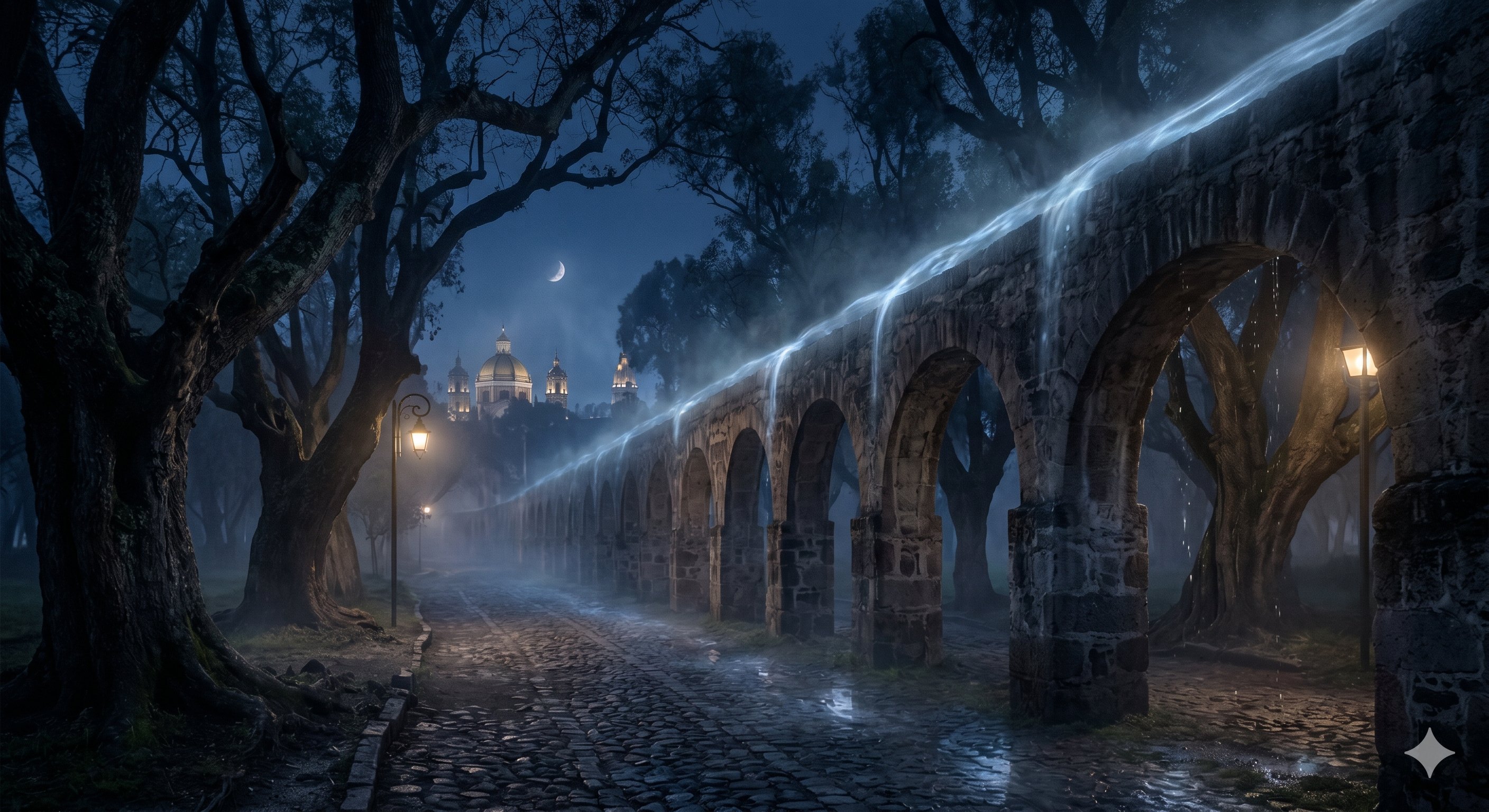
In the vicinity of Tercera Cerrada de Retoño 8, within the ancient village of San Sebastián Xoco —now absorbed by the modernity of the Benito Juárez borough— a ghostly geography survives that the asphalt has not been able to bury completely. Local chroniclers and attentive neighbors say that "The Night Orchard of Xoco" manifests only when the city's pulse stops; during that "strange hour" of deep twilight or early morning, when the roar of cars ceases and the neighborhood seems to reclaim its ancient breath to recognize whoever walks through its twisted streets.
This apparition does not require screams or terrifying figures to make itself known. Its announcement is subtle, purely sensory: it begins with a sudden, overwhelming aroma of ripe fruit —guavas, figs, sapotes, and hawthorns— that floods the cold air. It is the scent of the ancient Carmelite and family orchards that once defined this territory, sprouting from the cracks in the sidewalks as if the street opens a sonorous and olfactory crack towards a pending past. Those who have perceived it describe a feeling of deep peace, accompanied by the almost imperceptible sound of water running through invisible irrigation ditches.
The elders of Xoco assure that this manifestation does not seek to scare out of malice. Its purpose is permanence: it acts as a sensory bond so that no one forgets what was there before the large buildings and shopping centers. It is the memory of the original indigenous village, its devotions to the patron saint, its forgotten sorrows, its farming trades, and the footsteps of the ancestors who tilled that fertile land bathed by the Churubusco River. Therefore, the legend is inseparable from its geography; it needs that specific corner, the stone of the temple, or the wind that turns the corner to take shape. The signal arrives to correct anyone who confuses progress with oblivion; it is the territory speaking through its aromas before written history attempts to explain it.
Oral memory
Origin of the story
The Night Orchard of Xoco grows from a popular reading of San Sebastián Xoco. The cited source anchors the site and its historical context; the legend uses that ground to tell what the neighborhood imagines, fears, or preserves.
Territory
Territory and atmosphere
The story is set at Tercera Cerrada Retoño 8. That point is not decorative: the street, plaza, market, church, canal, or hill explains why the apparition is told there and not elsewhere in Benito Juárez.
Cultural reading
Cultural reading
The key to the tale is the scent of ripe fruit appearing in crooked streets where old orchards once stood. As an urban and neighborhood legend, it turns a territorial detail into warning, memory, or wonder so the local past can keep speaking inside the present city.