Full legend
The story
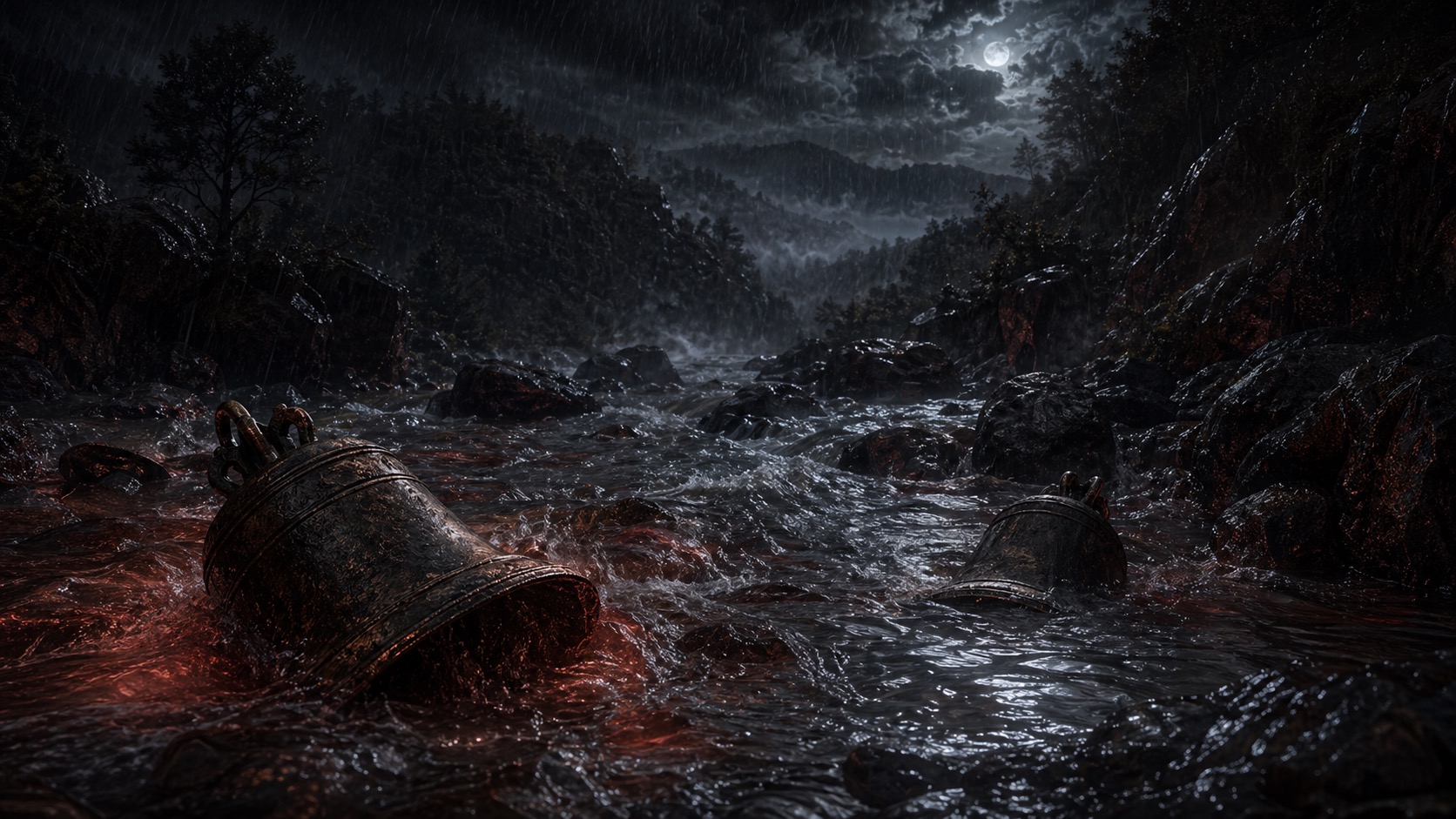
When the waters of Rio Frio rise with the rains and night turns the roads uncertain, peals begin to sound from no church anyone can name. At first they seem like distant bells; then something stranger, like bronze striking beneath the current itself. The older men of town say the river long ago carried away a small hermitage or roadside chapel, and that ever since its bells have been rolling through the stony bed.
They do not ring on a whim. Each time the pealing comes clearly, someone gets lost in the mountain, an animal slips, or a traveler fails to return when expected. That is why no one hears those notes as comfort. They are warning, anticipated mourning, and the memory of water gathered into the same sound.
An old muleteer once said that because of those bells his companion was saved. They were returning during a storm when the bronze began sounding so near that both men stopped out of pure fear. The one walking ahead wanted to continue, but the other refused and pulled the mules toward the slope. Minutes later a sudden surge rushed through the channel where they would have kept going. After that, rather than deny the legend, the man lit candles every rainy season to thank bells he had never been able to see.
That is what makes Rio Frio unsettling. It is not an evil sound, but a warning that always arrives with pain. If the bells ring, someone will suffer. Those who hear them do not celebrate; they go check roads, animals, and absences. In Tlalmanalco people say the water learned to speak through bronze because sometimes only fear can make the living hear in time what the mountain has been trying to warn them about from afar.
Oral memory
Origin of the story
The Bells of Rio Frio arise from one of the most common acoustic mysteries in rainy mountain regions: a sound the surroundings distort until it becomes unrecognizable. The elders of Tlalmanalco have said for generations that on nights of heavy rain peals can be heard that come from no identifiable church, and the explanation that endured was that of bells dragged away by an old flood, bells from some chapel the river carried off during one of its historic surges. The story also gives the sound a precise function. Each time it is heard, it announces an accident in the mountain, a fall, a disappearance, or a landslide that happens before anyone can prevent it. That turns the bells into an alert system the town hears even when it cannot act in time.
Territory
Territory and atmosphere
Rio Frio descends from the slopes of Popocatepetl and Iztaccihuatl with a force that can multiply its flow within hours during the rainy season. Its course, lined with fir and pine forest, creates a reverberant field where any sound travels unpredictably. What seems near may be far, and what seems far may lie around the next bend. Rain falling on river stones, wet leaves, and swollen water produces layers of noise the human ear cannot easily order in darkness. In such an environment, a peal with no visible source needs no supernatural explanation to be disturbing. The disturbance is already present in the landscape itself.
Cultural reading
Cultural reading
The legend turns an acoustic phenomenon into a communal warning system, and that shift is exactly what gives it cultural value. It does not explain the sound scientifically; it weaves it into a network of meanings where nature and human history merge. The submerged bells are the loss the river took away at some real or imagined moment, and their persistence in sound is how that loss keeps participating in the town's life. By announcing accidents, the bells are not passive but active. They are part of a territorial knowledge system that works without maps or radios and that elders still know how to hear even when the young no longer always can.